The intersection of architecture and fashion has always been a fertile ground for innovation, but few movements have sparked as much controversy and excitement as deconstructivism's explosive entry into bridal wear. What began as an architectural rebellion against rigid forms has evolved into a radical reimagining of the wedding dress - tearing apart traditions with the same fervor that Frank Gehry's titanium curves shattered conventional museum designs.
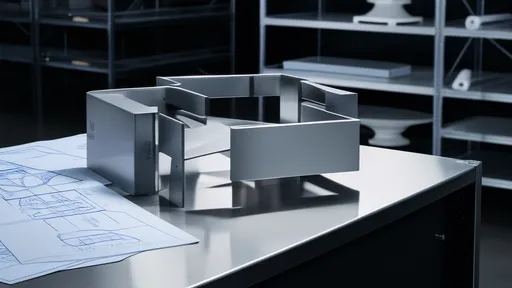
At its core, deconstructivist bridal fashion isn't about destruction but revelation. Like peeling back the layers of a building to expose its structural poetry, avant-garde designers are dissecting the very DNA of wedding gowns. Seams burst outward like fractured concrete, tulle cascades in calculated chaos reminiscent of Zaha Hadid's fluid geometries, and corsetry appears halfway between assembled and dismantled - a sartorial equivalent of Daniel Libeskind's angular voids.
The movement's pioneers treat fabric as architectural membrane, manipulating textiles with the same spatial awareness that shapes deconstructivist buildings. One can observe this in Iris van Herpen's 2023 bridal collection where laser-cut leather mimics the fractal patterns of collapsed scaffolding, or in Rei Kawakubo's controversial "Bride" line that positioned the wearer as both monument and demolition site. These creations don't simply hang on the body - they engage in active dialogue with space, creating kinetic tension between form and void.
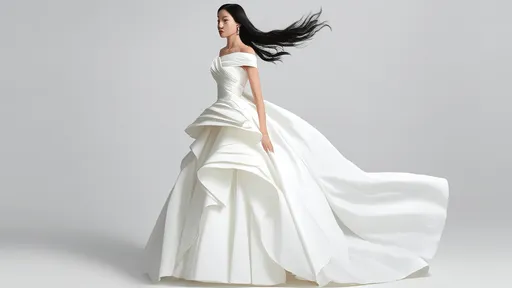
Traditional bridal silhouettes have been exploded from within. Where once stood the pristine dome of a ballgown skirt now rises jagged asymmetry, like the skeletal remains of a cathedral after controlled implosion. Designers such as Yiqing Yin construct dresses that appear mid-transformation - one shoulder intact while the other dissolves into floating organza shards, echoing the fragmented façades of Coop Himmelb(l)au's early works.
Material innovation drives this revolution. Architects turned couturiers employ 3D-printed polymers that mimic shattered glass, memory alloys that reshape themselves throughout the ceremony, and translucent concrete-like textiles that play with opacity gradients. The result are gowns that challenge perception - is that a collapsing bustle or an avant-garde interpretation of a flying buttress? The line between structural failure and intentional design becomes deliciously blurred.
This movement extends beyond visual shock value. Much like how deconstructivist buildings reveal their engineering through exposed elements, these wedding dresses celebrate their own making. Raw edges showcase hand-stitching as craftsmanship rather than flaw, boning erupts from bodices like exoskeletons, and lining materials appear unexpectedly on the exterior - a sartorial parallel to the Pompidou Center's inside-out aesthetic.
The cultural implications are profound. Where traditional bridal fashion seeks to present perfection frozen in time, deconstructivist gowns embrace process, transformation, and even decay. Some designers incorporate elements that literally change during the ceremony - hems that unravel to reveal hidden messages, detachable panels that guests can remove as symbolic gestures. It's wedding as performance art, with the dress serving as both costume and evolving set design.
Critics argue these creations prioritize concept over wearability, but their influence permeates mainstream bridal. Elements once considered radical - asymmetrical necklines that mimic sheared metal, "unfinished" hems that recall construction sites - now appear in modified forms at premium bridal salons. The movement has also sparked fascinating hybrids, like Viktor & Rolf's gown that appears traditionally voluminous from one angle but reveals explosive deconstruction when the bride moves.
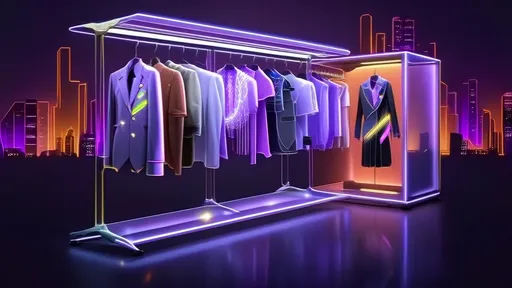
Technology accelerates the possibilities. Parametric design software originally developed for complex architecture now generates dress patterns with algorithmic precision. Laser cutters achieve levels of detail impossible by hand, allowing for micro-deconstruction where each thread seems individually considered. Some designers even use augmented reality to let brides experience how their gown's "collapse" will progress throughout the wedding day.
Perhaps most remarkably, these designs are shifting perceptions of what bridal beauty means. The fractured, the incomplete, the unstable - all become virtues rather than flaws. In an era where marriage itself is being deconstructed and reconstructed, perhaps it's fitting that its most symbolic garment leads the charge in celebrating beautiful rupture and glorious imperfection.
The future promises even bolder fusions. Experimental designers are collaborating with robotics engineers to create dresses that physically reconfigure themselves, while others explore "living" gowns incorporating bioluminescent algae or shape-shifting microbial cellulose. As architecture continues pushing material boundaries with self-healing concrete and 4D-printed structures, bridal fashion follows suit - sometimes quite literally, with one designer recently creating a train that reassembles itself like a collapsing bridge in reverse.
This isn't merely fashion borrowing architectural aesthetics. It represents a fundamental rethinking of clothing as temporary shelter, the body as inhabitable space, and marriage as an act of creative destruction. The deconstructivist wedding dress doesn't just clothe the bride - it architects an experience, one fracture, fold, and unexpected void at a time.
By /Aug 13, 2025
By /Aug 13, 2025

By /Aug 13, 2025
By /Aug 13, 2025
By /Aug 13, 2025
By /Aug 13, 2025

By /Aug 13, 2025
By /Aug 13, 2025
By /Aug 13, 2025

By /Aug 13, 2025

By /Aug 13, 2025

By /Aug 13, 2025
By /Aug 13, 2025
By /Aug 13, 2025

By /Aug 13, 2025

By /Aug 13, 2025

By /Aug 13, 2025
By /Aug 13, 2025

By /Aug 13, 2025

By /Aug 13, 2025
